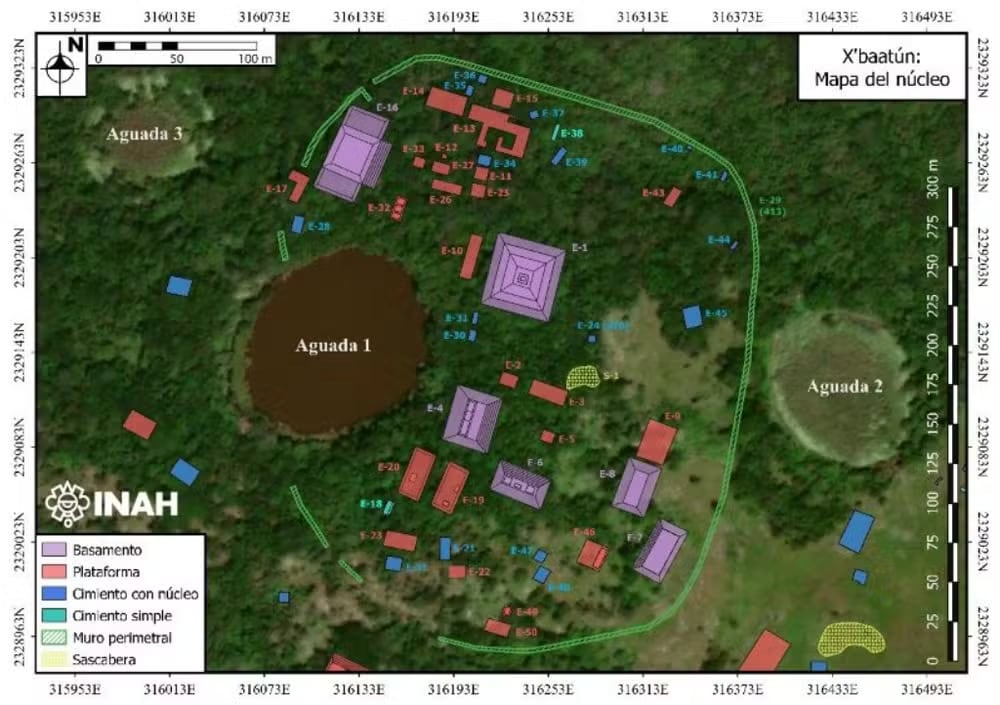
In brighter news, archaeologists working in Mexico’s Yucatán Peninsula confirmed the existence of a Maya city occupied between 700 and 1,200 A.D. that turned out to be far larger than anyone expected. The site at Tekal de Venegas, explored by the X’baatún Project, contained approximately 60 structures within a walled core spanning 9 kilometers. The nearby site of Kukulá formed part of an even broader urban complex whose total boundaries remain undefined.
And in New Mexico, fossils excavated over a century ago received a dramatic reclassification. Remains long attributed to the genus Kritosaurus were identified as an entirely new species of hadrosaur — Ahshislesaurus wimani — a herbivore that roamed the earth roughly 75 million years ago during the late Cretaceous period. The fragments of skull, lower jaw, and vertebrae had been sitting in the Smithsonian’s National Museum of Natural History since their discovery in 1916.