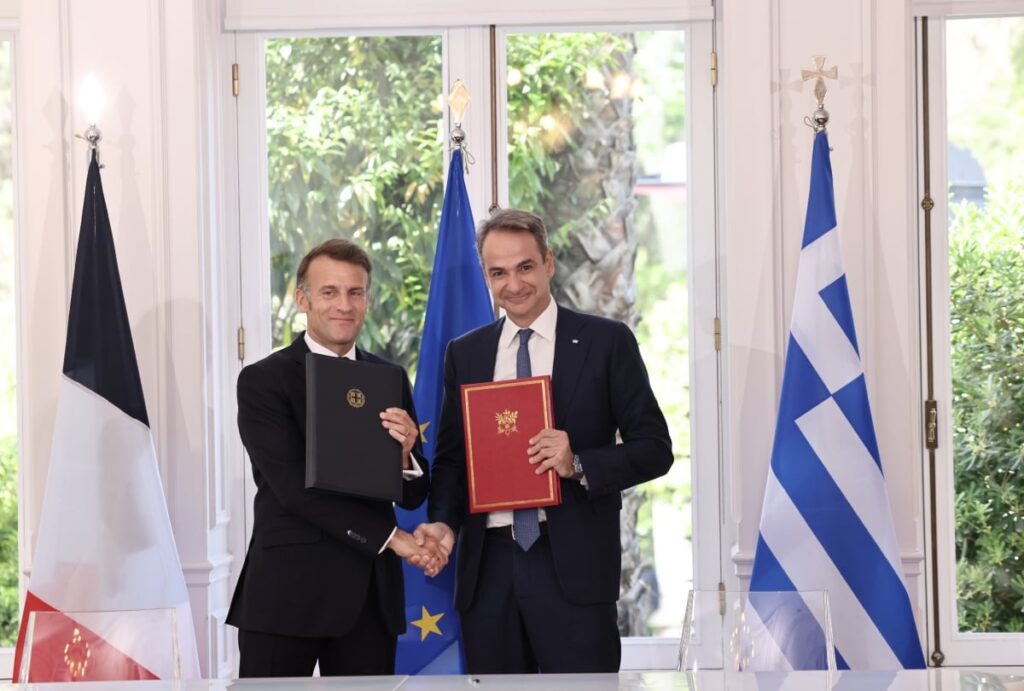
In an atmosphere described as “exceptionally friendly,” Greek Prime Minister Kyriakos Mitsotakis and French President Emmanuel Macron reaffirmed the strategic alliance between their two nations on April 25, signing nine bilateral agreements and delivering what one commentator called a message of solidarity during a particularly volatile period in the Eastern Mediterranean.
The centerpiece of their joint declarations was an emphatic endorsement of Article 42.7 of the EU Treaty — the bloc’s mutual defence clause — which Mitsotakis described as “reinforced concrete.” The renewed Strategic Cooperation Agreement upgrades the original pact signed between the two countries in 2021, expanding its scope and commitments.
The visit carries particular weight given the ongoing war in Iran and broader instability in the Middle East and Gulf regions. As one Greek editorial put it, “Greece–France–Europe alliance” is not merely a political slogan from the post-junta era — it is “a reality with specific arrangements and commitments reflecting the spirit of civilization and democratic values that connect the two countries.” Macron, who is expected to leave office within months, used the Athens visit — following an informal European Council meeting in Ayia Napa, Cyprus — to underscore the durability of the Franco-Greek partnership beyond his own tenure.
Meanwhile, across the Atlantic, former U.S. President Trump claimed progress in Middle East conflicts, though analysts noted that Iran, despite suffering severe blows, has not shifted its posture at the negotiating table — a reminder that the geopolitical backdrop to the Mitsotakis-Macron meeting remains deeply unstable.