
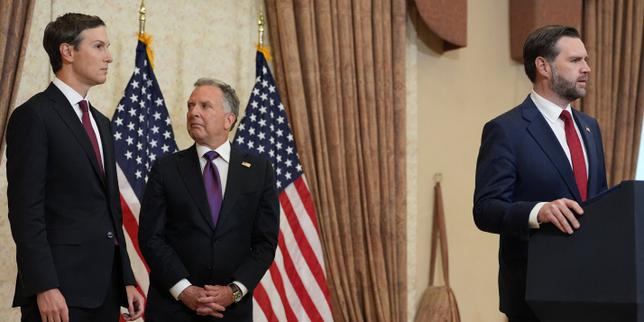
In what may prove to be the weekend’s most consequential development, President Donald Trump cancelled the planned travel of his top envoys — son-in-law Jared Kushner and special envoy Steve Witkoff — to Islamabad, where they were set to continue negotiations with Iranian officials. The announcement came shortly after Iran’s Foreign Minister Abbas Araghchi departed the Pakistani capital.
Trump conveyed the news via individual phone calls to journalists and later on social media, telling Axios that pulling his representatives did not mean the United States intended to resume the confrontation with Iran that began on February 28. “I just cancelled the trip of my representatives who were going to Islamabad, Pakistan,” Trump said, without providing a detailed explanation.
The move introduces fresh uncertainty into an already fragile diplomatic process. Le Monde and Costa Rica’s La Nación both reported the cancellation as a major breaking story, noting that Vice President J.D. Vance had previously participated in talks in Islamabad earlier in April. Meanwhile, Islamabad’s own administration was cautiously reopening the city — restoring public and goods transport, reopening parks and hiking trails — though the Faizabad bus terminal remained closed “until further notice,” a sign of the security posture still in place around the diplomatic activity.
Adding another layer to the US-Iran story, geostrategic analyst Christopher Helali told RT from Isfahan that the US operation inside Iran in early April — which resulted in the confirmed loss of two MC-130J Hercules transport planes, four MH-6 Little Bird helicopters, an A-10 Thunderbolt, and an MQ-9 Reaper drone — was actually a failed attempt to seize Tehran’s enriched uranium, rather than the rescue mission Washington described.