
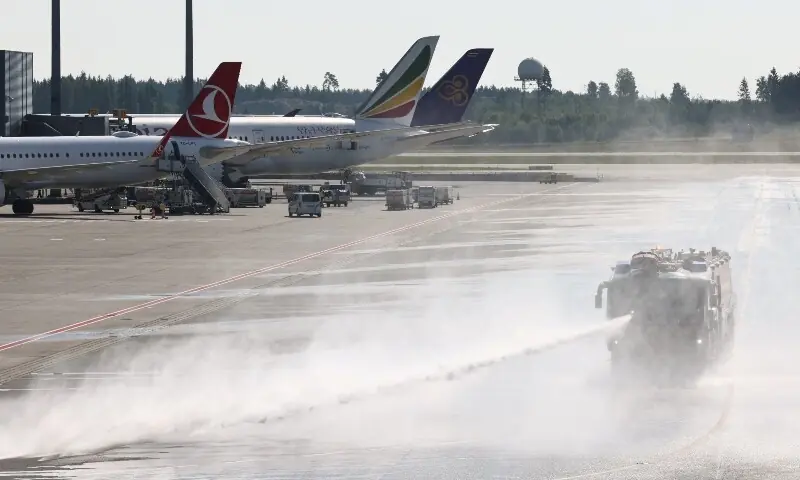

While the world watched football, Europe was literally melting. From Norway to Spain, the continent faced an escalating infrastructure emergency driven by record-breaking temperatures.
At Oslo’s airport, with temperatures hitting 30°C — a full 10 degrees above normal — workers resorted to dousing tarmac with water to prevent it from softening. It’s a striking image for a country historically engineered for cold. “In Norway, the asphalt must withstand both extreme cold and fairly warm temperatures,” noted Jørn Arvid Remark, an infrastructure official.
Across the continent, countries are deploying an increasingly creative arsenal: drones to inspect buckling railway tracks, AI-powered sensors to monitor stressed power grids, and — perhaps most surprisingly — white paint applied to roads and rooftops to reflect heat.
In Spain, the crisis was more immediate and dangerous. Authorities in Aragón ordered the evacuation of three towns as a wildfire raged out of control, forcing the regional government to call in the UME, Spain’s military emergency unit.
Meanwhile, across the Atlantic, wildfire smoke from Ontario blanketed Toronto, degrading air quality in one of North America’s largest cities. The iconic CN Tower was barely visible through the haze.
On a more optimistic note, Germany reported a quiet milestone: heat pumps became the most commonly installed heating system in 2025 for the first time, according to the Institute of the German Economy — a concrete sign that the energy transition is gaining traction, even as subsidies are expected to decrease. And in Italy, electrified vehicles now account for 54% of the summer rental car market, reflecting a broader green shift in tourism.

